In addition to having spent more than 15 years in the technology business, only a few people know that I am a licensed insurance adjuster, able to help out in times of disaster like the recent Super Storm Sandy. While I will never claim to be an adjusting guru, I do have a few hundred claims under my belt and am quite versed in not only the technology involved in the property claims industry (such as being Level III certified in Xactimate), but also the operations side.
In my experience as an adjuster, I have had the benefit of working with a number of carriers, both regional and national, as well as several IA and TPA firms - not only as an FA, but as a technology consultant. Having just attended the usual pre-storm-season cadre of conferences and workshops, I felt compelled to document 4 areas where I see an opportunity for fast, easy and inexpensive improvement that would make a tremendous difference for IA/TPA firms and/or carriers in processing claims, whether daily or CAT:
1. Information Access
The first area most adjusting firms, and even carriers, hamper the field operations process is access to necessary information. Particularly during the mayhem of a CAT, field adjusters and other personnel are constantly exchanging emails (and phone calls) - 67% of which could be eliminated! So much of it is about information on policy docs, claims handling guidelines, and so on.
Then, there are the folks who send out flash drives. Sure, it's not that expensive anymore, but what do you do during a situation like Sandy, when you have dozens of adjusters coming from all over, and you don't have time to get flash drives into their hands? Also, what happens when a document needs updating?
Providing simple, self-service access to this information, through a document portal, would free up internals and ops personnel to handle more important, or claim-specific issues. Even more important, the field personnel don't have to wait, sometimes several hours, for internal ops staff to sift through the hundreds of emails they receive, and find the necessary information, to respond. Here are the most common things I see needing to be more readily available to field personnel, especially adjusters:
-
Current policy documents
-
Internal contact info
-
Claims handling guidelines
-
Approved vendor lists
Deployment of a web portal for access to such information needn't be expensive or complicated. Many organizations fear large, costly and complex solutions like Microsoft Sharepoint due to the IT staff and resources (not to mention licensing fees) necessary to deploy it. Other options, like DropBox and other various and sundry 'cloud' solutions present other drawbacks, like the need to install 'client' software on users' PCs, which presents potential security, maintenance and document version issues.
2. Imparting Knowledge
The second most important area, and probably the one most lacking, is disseminating knowledge, especially during times like a catastrophe, when many new or 'rarely utilized' personnel are activated. This is different than the aforementioned providing of access to information and gets more into training.
Everyone knows adjusters "don't read claims handling guidelines or other instructions." Why is that, and what would it be like if they did?
They don't read them for several reasons, besides being lazy: Written guidelines are typically not only tedious, but often difficult to understand. Even if every adjuster read every guide ever handed to them, they would only retain so much - only 10% according to this well-known chart about learning retention:
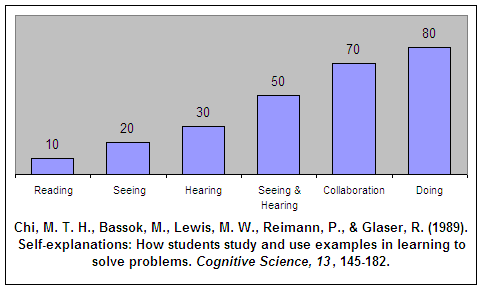
According to the chart, retention increases to 50% using audio/visual presentation - hence why multimedia training has become such a popular tool. This chart, and further studies on the matter, show that retention and understanding are increased significantly (to 80% or more) by "doing" whatever is being taught.
Now, I've read numerous guides, and sat through many training sessions held at the beginning of storm season. By the time a storm actually hits, even having been "trained," I still have to refer back to the guides (if they're available) or ask questions because I either did not retain 100% of what I learned, or I learned it so long before I needed it, that I forgot some (or much) of it.
The point? The best way to ensure the highest understanding and following of procedures and guidelines is to make it auditory and visual, and available immediately before use. How do you do this when all of your folks are scrambling to prepare for the storm? Put it online!
I have often suggested to field ops managers that it would be GREAT to have some sort of multimedia tutorial on their claims procedures, operational systems (how to access their CMS, etc.), and even carriers' requirements, that I could quickly review prior to handling their claims.
Simple publishing solutions like Vistalogix's own Document Library make it easy to post video presentations to your extranet. However, for those who really want to do it right, like tracking which personnel have taken which training, or even offering CE credits, a Learning Management System (LMS) is the way to go - and it doesn't have to cost an arm and a leg!
3. Communication
The first two items are the "lowest hanging fruit," while what I am going to suggest with regard to communications requires a little more pre-planning.
I know at least a dozen IA/TPA firms whose offices are located in coastal or hurricane-prone areas. Some are even in evacuation zones. Furthermore, most of these firms operate their primary communications systems - email and phone - from within their premises. So, how do you handle hundreds of claims when your phone system and Exchange Server are flooded or without power, or your offices have been evacuated and are inaccessible?
This doesn't even get into the issues I come across on the technology side, like the fact that organizations allow unsecured access to their email servers from the Internet, and so on.
These are things I'm starting to see the more sophisticated carriers look into when even contracting with an IA or TPA firm: Never mind how many adjusters they say they can provide - how available will their operations be in the event of a CAT hitting their local area? How reliable and SECURE are their communications systems? Are they using GMail/Yahoo/AOL for their email - providers who "sniff" every email that comes across their network for marketing information? (See our previous article on Google's privacy.)
Services like RingCentral or Vistalogix's Enterprise Email, or Hosted Exchange allow even the smallest firms to get these crucial systems offsite and into hardened, disaster-proof datacenters so they are assuredly available at all times - and often at a lower cost than managing them in-house. Furthermore, having remote access to these systems allows for easy relocation of primary facilities and field operations (internal phone extensions and email can be available anywhere with Internet access - even via satellite). These services also typically provide more secure, SSL encrypted connections and require almost no management.
Adjusting firms may consider providing email addresses for FAs. This ensures security and avoids issues like lost emails and delays commonly associated with GMail/Yahoo/AOL. It also keeps control in the hands of the firm for archiving/records retention or re-routing/forwarding of email in the event of reassignment.
4. Customer Satisfaction
I know of a few carriers who prize customer satisfaction enough that they actually have FAs solicit a brief survey during inspections. I know of many more who should be, or want to do this. Heck, I even know of one adjusting firm who does it - of course, it is one that I am partners in!
Of course, the first method of collecting surveys has a pretty significant downside: The insured is not going to slam the FA for poor customer service when they know they're going to hand the survey back to the FA and, in their perception, possibly be unfairly treated by the FA when estimating the damages.
There is also the problem of FAs forgetting to collect or turn in the surveys, especially during a CAT. I'm guilty of this myself.
What better way is there to do it? Online, post-inspection, with the insured not being influenced by the FA's presence. This also allows more time to elapse and the customer to have more experience throughout the claims handling process - assuming you want to accurately identify customer service issues (if you just want good stats, then earlier is better).