|
 News & Updates
Florida's Public Records Fishing Tournament
 Most people, some would argue "too many," having anything to do with government, whether a taxpayer, employee, or elected official are familiar with federal and state open records, or "Sunshine," laws. Most people, some would argue "too many," having anything to do with government, whether a taxpayer, employee, or elected official are familiar with federal and state open records, or "Sunshine," laws.
However, a new sport has been gaining popularity, and the grand prize is potentially a huge expense to taxpayers: public records fishing.
The SNAFU
Historically, public records requests have been relatively manageable, particularly by smaller, local municipalities. However, with the increasingly litigious and politically contentious climate, the number of "legitimate" records requests has not only increased, but the number of requests simply "fishing" for possible dirt on, or outright attempts to harass, public officials has driven the cost of compliance through the roof.
According to some folks we spoke with, who requested to not be named, they are now seeing requests from not only the usual "watch dog" citizens, but from a number of unscrupulous attorneys and others. In some cases, these requests appear to be simply flushing out errors in compliance.
While accountability is a key component in the foundation of our government, excessive and unnecessary activity such as that which is now being seen, is not only abusive, but is costing taxpayers a fortune - to the tune of more than $10,000-$15,000 per search in some cases.
What Some Are Doing
A number of state and local government entities, including special districts, have started charging fees for the additional time and materials necessary to respond to a public records request. This has met with mixed greetings, as many citizens feel that accountability is included in their tax bill, and such accountability should be available to everyone, not just those who can afford to pay for it.
Another approach has been to provide more self-service to the requestor. The court clerks have been doing this for years with the public filings. However, now, with the availability of secure digital media, internal documents, and even email archives are able to be made available for public (or registered public) search. In the event that the requestor doesn't wish to search through the thousands of emails or documents themselves, it becomes easier to justify the additional charges to have a staff member do it for them.
"With the budget cuts, our staff don't have time to do all of the extra work that's been piled on them. They certainly don't have available time to dig through years of emails and documents just because someone thinks there might be some impropriety - whether they're paying extra for it or not," remarked another staff member we spoke with.
Uncovering A Key Issue
With the varying methods of addressing the records fishing issue, one issue has come to the surface for a number of organizations, particularly smaller municipalities and special districts: ability to comply. This creates a potentially significant liability for those who are not already fully compliant - and in many cases believe that they are.
Over the recent months, Vistalogix has received a number of calls relating to ensuring public records compliance. Some of these calls were in response to clear fishing activity, which prompted this article.
The most common area of non-compliance? Email. Several offices we've spoken with, some clients, some not, either hosting their own Microsoft Exchange Server, using Gmail, or using their ISP's basic email service, were shocked to learn that they had potentially serious issues with archiving.
 Most offices questioned had a simple process of providing copies of emails from the individual staff member's or official's email account to the requestor via a publicly available PC. From a mere efficiency standpoint, this means they have to manually sift through the potentially thousands of emails in a given user's account, or at least copy each user's data, including their Sent Items, to the pulicly available PC. Most offices questioned had a simple process of providing copies of emails from the individual staff member's or official's email account to the requestor via a publicly available PC. From a mere efficiency standpoint, this means they have to manually sift through the potentially thousands of emails in a given user's account, or at least copy each user's data, including their Sent Items, to the pulicly available PC.
However, what happens if the staffer or official has deleted some of the emails, either accidentally, or intentionally? Now they have a serious compliance problem on their hands! Relying on individual users to retain all of the necessary emails that may become part of a public records request, even years down the road, is risky at best.
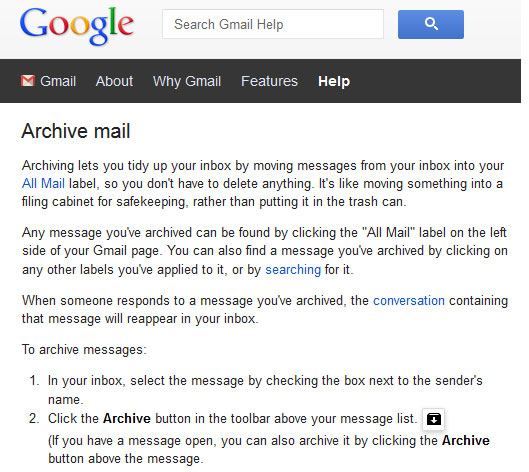
Even the GMail users were shocked to learn that they were similarly exposed, with Google's so-called "archiving" requiring users to manually move emails from their inboxes to an "archive" folder.
One Problem Solved
Best practice for solving this simple issue involves capturing all incoming/outgoing emails for your organization. This means having everyone use the same system or domain for all government-related communications, such as individual.name@yourcity.gov (no commissioners using their personal GMail, Yahoo, or whatever accounts).
Then, all emails should be captured, behind-the-scenes, into a separate archive. For Vistalogix's basic email service, this is a mailbox typically called archive@yourdomain.gov. This mailbox then serves as a single location that can be searched, either by your staff, or by the requestor if you wish.
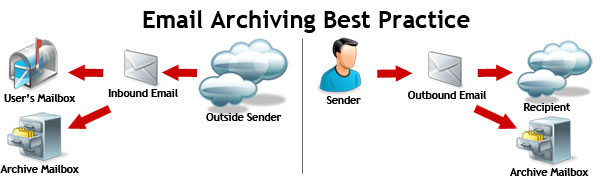
Another option, which we provide for our larger clients who use our hosted Microsoft Exchange service, is to have a 3rd-party service (or hardware appliance for those with appropriate in-house infrastructure) capture all emails on a regularly scheduled basis. In most cases, this is done daily. Using this method, however, care must be taken to ensure that emails cannot be removed by the user prior to being captured.
Second Problem Solved
Providing self-service access to internal documents provides a great means of reducing cost, and it can be done relatively inexpensively. However, some documents, such as those requiring redaction of certain information, are not as conducive to making available via self-service access.
Documents, apart from the obvious meeting agendas and minutes already published by most entities, that are easily made available for self-serve search and review include:
- Bid documents, responses and awards
- Budgets and financials
- Planning documents
- Employment solicitation and payroll information (with information such as social security numbers redacted)
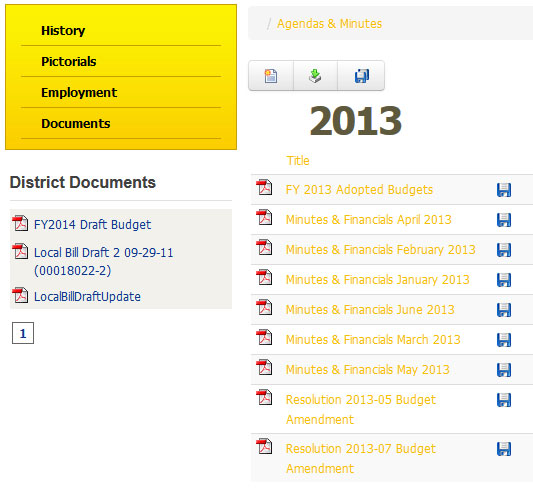 The method many of Vistalogix's clients use for making these documents available is to employ our Document Library module and create an appropriate folder hierarchy that is accessible to the public. In some cases, entities make some documents available without registration on their sites, while other documents require a no-charge registration to gain access. The method many of Vistalogix's clients use for making these documents available is to employ our Document Library module and create an appropriate folder hierarchy that is accessible to the public. In some cases, entities make some documents available without registration on their sites, while other documents require a no-charge registration to gain access.
In some cases, this online document library is used as the primary repository for all documents, even those not readily available to the public. This provides a means of offsite disaster preparedness, as well as remote access to documents for staff and others. Personnel appreciate the ability to still get work done while at home or traveling. This further simplifies the process of making appropriate documents available to the public.
Measuring The Cost
Regardless of how you choose to address compliance with public records requests, it is a good idea to have a mechanism in place to at least keep track of them and ensure that they are handled in a timely manner. A ticketing system, like the Request Tracker built into Portfolio, makes a good solution for making sure nothing falls through the cracks.
Another good idea, employed by other Vistalogix clients, is to closely track the costs of responding to records requests, using a tool like our Workforce Optimizer. This not only helps show citizens what public records compliance is costing them, but may help justify implementing additional fees for requests.
The Future of the Species
 The long-term affects of this trend are not yet clear. However, it is clear that compliance has become more important than ever - government administrators' and clerks' jobs may depend on it, not to mention elected officials, as we have seen on more than one occasion throughout the last year or two. The long-term affects of this trend are not yet clear. However, it is clear that compliance has become more important than ever - government administrators' and clerks' jobs may depend on it, not to mention elected officials, as we have seen on more than one occasion throughout the last year or two.
While larger entities are spending thousands, and even millions on compliance, this need not be the case for smaller entities. In many cases, compliance is simply a matter of "working smarter, not harder." Vistalogix has produced a guide to government compliance, which may be obtained from our website.
|
|